Tuesday, July 15, 2008

What's that on your nose?


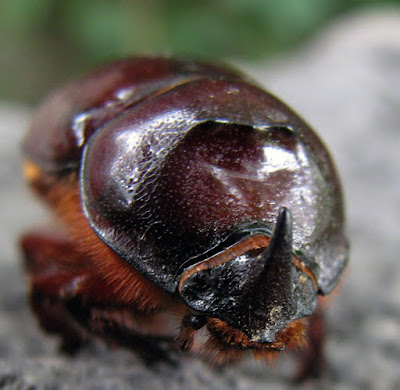
This magnificent creature is a rhinoceros beetle – one of the largest and most fascinating beetles in Armenia. When I was a kid, first collecting bugs, then photographing them, I really wanted to find one, but never did. So, this here monster represents my childhood dream come true!

Some interesting facts about rhino beetles, gleaned from books and Internet: they are mostly useful creatures, their larva feeds on rotting wood, recycling it back into the ecosystem, only males have the horn and use it for territorial/food fights with other males. Females are larger, but with no horn.

What I find fascinating about these beetles, is that they are considered among the strongest creatures in the world. A rhino beetle is said to be able to carry 850 times its own weight!

The close relatives of this guy are the huge African rhinos, some of them as big as the palm of your hand! This European cousin is only about 5-6 cm (2-2.5 in) long. But he does have an imposing appearance, doesn’t he?
Wednesday, June 11, 2008

AN ODE TO OUR LONG-EARED FRIENDS

Even a brief look at Armenian folklore will reveal the following fact: a donkey was by far the most popular animal with our ancestors, featured in more folk tales, sayings, proverbs, idioms and jokes than any other character (okay, maybe dogs are mentioned quite as frequently). This is easily accounted for, if you remember that Armenia is a mountainous country where, before the heavy machinery even existed to dig roads and tunnels, most traveling and cargo transportation was done via narrow mountain paths. A donkey was indispensable for this sort of thing, better even than a horse, especially because not everyone could afford a horse. So there you have it – please welcome the hero of Armenian national folklore!


Though it is a thankless task to translate idioms and proverbs, I will site some donkey-related ones, still widely used:

You will often hear a stupid and obstinate person being called a donkey, donkey head or, if the stupidity is particularly irritating – a donkey foal. (These expressions are particularly popular with drivers and politicians these days.) Similarly, to speak like a donkey means to say something stupid. And if someone is especially obstinate and insists on getting his own way no matter what, he will certainly be described as spurring his donkey on.

Someone who is sluggish or tuned out will be dubbed slumbering in a donkey ear. For instance, if you are the last one to hear that your boss is marrying his secretary after 7 years of relationship, you were definitely taking a nap in one of those furry ears.

The condition of mountain roads and the rocking gait of an average donkey must have been the reason why a person who is feeling tired and beaten will describe himself as having just dismounted from a donkey. Somewhere along those lines goes the following saying: mounting a donkey is shame, getting off is twice the shame. I think it means: if you took something upon you - do it, no matter how unpleasant the task is.

Don’t die, donkey – spring will come, grass will grow describes empty promises. Others might be donkeys, we are just a donkey saddle is to say - life/progress is passing us by. Looking for a dead donkey to take the shoes off usually describes an opportunist, or someone taking advantage of others. Pull the donkey out of the mud means to survive a challenge (if you didn’t study for the test and got an A just using your wit, this would be a very appropriate thing to say)


Ate the donkey, turned away from the tail – my mom would say when I run out to play leaving the last sentence of my homework unfinished (didn’t happen too often). And if I didn’t appreciate something yummy she made, her comment was: what does donkey know about almonds? Loaded donkey runs faster – she would sigh taking yet another task upon herself.


A donkey, even if it makes 40 trips to Jerusalem, will still be a donkey – doesn’t need much explanation, I think.


All this aside, however, donkeys are rather smart animals, if somewhat obstinate and loud. They are tough, hard working and cheap, and to this day are still popular throughout the countryside. What with the rising gas prices, I am thinking about getting one myself!


To conclude, a fable by a 13th century Armenia writerVardan Aygekci.


Messengers came to a donkey: “Rejoice and be glad and prepare gifts, you had a grandson.”
“Woe to me, friends”, - the donkey answered. “Even with hundred grandsons, my load will remain just as heavy.”

Friday, May 23, 2008

SOS

If you look at the map of Armenia, you will notice in addition to Sevan Lake in the middle and several smaller water reservoirs in various areas, a group of strange, geometrically shaped lakes in the southern corner of the country. These are artificial fisheries of Armash, bordering with the "no man’s land" between Armenia and Turkey, and there we went last Sunday with a small group and the President of the Center of Bird Lovers of Armenia as a guide.

What makes the fisheries special is the amount and diversity of water birds there. After some other lakes in Armenia were drained or the habitat around them destroyed as a result of human activity, the birds started making their nests at the fisheries, which are surrounded by reeds and are rich with food. Beside the ducks, herons and egrets, terns and cormorants of all shapes and sizes, that are fairly common (even though some of those are threatened too,) there are some spectacular birds that live here – spoonbill, glossy ibis and black stork, for example. Pelicans and flamingos, that are not native to Armenia, stop over at the lakes during their migration.

Seeing as the lakes are practically the last resort for these birds in Armenia, you would think this a wonderful opportunity to dedicate at least part of the vast territory of the fisheries to a bird sanctuary, close it to hunting and fishing and open to kids, families and birdwatchers. Not so fast! The government does not seem in the least bit interested in stepping in, and the owner of the land, it seems, couldn't care less about endangered species (let me put it this way - he is yet to prove that he does). All that matters is that these birds eat fish. He grows fish for profit, and they eat it! So, without further ado, he sets to destroy them every which way he can. Besides regularly burning the reeds with nests, eggs and babies, he also allows an Italian-Armenian joint venture tour company to bring over groups of hunters to shoot the birds and has his own people shooting them as well, as they proudly boasted to us while we were walking around the lake. “They eat fish” said the young man with a gun showing us a shot black crowned night heron, a squacco heron and a duck.

The zoologists approached the owner of the fisheries more than once, asking him to stop allowing hunters to the lakes, but the answer still stands as negative. By the most optimistic predictions, it won't take long until the birds stop returning to these ponds, and will move to our southern neighbors for permanent residence. If they don't disappear altogether.

Sad.


Tuesday, May 20, 2008

Where do stork babies come from?

The photo is clickable-enlargeable. Did you notice how many sparrows make their nests on the outskirts of a stork nest?

Wednesday, April 9, 2008

Two brothers

These two gorgeous creatures are, in a way, brothers, belonging to the same family of swallowtail butterflies. The first one is called Machaon, the second - Podalirius. Interestingly, in Greek mythology those two characters were brothers, too!


Here is a quote from Wikipedia, if you are interested.
In Greek mythology, Machaon was a son of Asclepius. With Podalirius, his brother, he led an army from Thessaly (or possibly Messenia) in the Trojan War on the side of the Greeks during the Trojan War. He, along with his brother, were highly valued surgeons and medics. In the Iliad he was wounded and put out of action by Paris. Machaon (or his brother) healed Philoctetes and Telephus during the war. He was killed by Eurypylus in the tenth year of the war. He was buried in Gerenia in Messenia, where he was worshiped by the people. The Papilio machaon (Old World Swallowtail) is named after Machaon.

Monday, March 10, 2008

How do you know it's spring?


Because the storks are here!!!

Wednesday, April 11, 2007

So, what furry creature was born in our house recently?

On our big hike last summer, among other interesting creatures, we found a monster of a caterpillar - the size of a grown man's thumb, with spikes and hair, bright yellow with neon blue. This alien-looking creature was crawling across a rocky slope, where it was spotted by Roxy and, after posing in front of my camera, duly boxed and delivered to the city. I knew that if a caterpillar leaves the feeding site (plant) and starts crawling around looking for shelter, that means it's going to turn into a pupa soon, so I wasn't worried about getting food for it.


Here it is getting acquainted with Roxy's arm.


Soon after we returned to the city, the caterpillar started weaving a cocoon. In three days it produced enough silky thread to clothe the people of China! Finally, the cocoon was ready and the caterpillar disappeared from the view behind the fuzzy walls.

This is all we could see from outside.

What happened inside was that the yellow caterpillar turned into a brown pupa - the strangest of all stages in insect's life.

Here's the pupa which we discovered later inside the cocoon.


In this motionless state the caterpillar spent the entire winter. So that the conditions would be close to natural, we kept it out on a balcony - where the temperature was below freezing. If I didn't have a balcony, I would have to put it in the fridge.

In April, we brought it back inside and I warned everyone to keep an eye on it - it was time for it to come back to life. Whatever was hiding inside the cocoon was ready to emerge from it any minute.

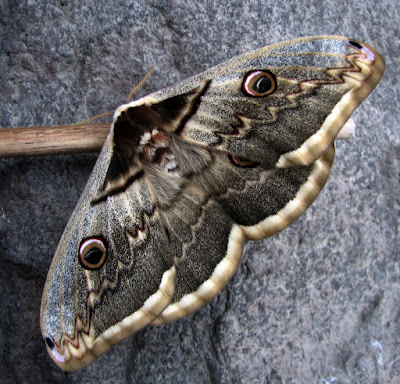
Sure enough, on April 3rd Roxy called me at work and told me that there is a moth with folded wings sitting on the cocoon. Just as we expected, the monster caterpillar turned into the largest moth in Europe - a Giant Emperor (otherwise known as Giant Peacock) Moth. It was a female, with not-too-large antennae and a very large belly.

Here she is - a headshot. Fuzzy, isn't she?

It took a while for the wings to unfold completely. For several hours the moth was sitting motionless and upside down, letting the blood flow through the little veins inside the wings. We took advantage of it and shot as many pictures of it as we could.

Here is a perfect example of protective coloring - with wings folded as they are the moth resembles a face of a large animal. Stay away!


Roxy admiring the gorgeous creature perched on a wooden spoon handle.


Finally, the wings spread out and the moth was getting ready to fly. The only problem- she was in the middle of a big city, and all other moths of the same kind were 50 kilometers away, in a river gorge by Garni village. I am sure she would have no problem flying that far if only she knew she should - but she wouldn't know. Besides, there are too many dangers for such a large moth in an urban setting.

So, Roxy and I took a bus to Garni, which is about an hour away from Yerevan. It was really cold, and actually snowing there - but we hoped that our newborn will survive a few days until the weather gets better. Here is the moth's home as it looked that evening.
We out her in a tree by the gorge, where she could hide away until it stops snowing. I took one last picture of the moth and we returned to the city. I hope to go back next summer and see those magnificent creatures flying around at night. maybe, we will find another caterpillar, too.


Monday, February 12, 2007

The Zoo in the winter

I didn't even know our Zoo is open in the winter. Turns out it is, and most animals feel pretty good surrounded by snow. Plus, we got to see many of them in their winter coats, which was quite a treat. It's usually much lighter in color, thick and lush and very pretty.


The lynx, for one, is reddish-yellow in the summer. Now it's napping wrapped in beautiful silver fur.


This wild cat (serval) definitely had something to say! Something hissy.


You know the friendly young people in khaki shorts and colorful animal-themed shirts that run around the LA Zoo and answer your questions? Well, we got them too! There!


Can't help but calling this one "a hog on ice". I know, I know, it's too obvious...

And this one - "Hoot".


Wanna sit down?


This deer didn't like us, I think. Otherwise, why would it be sticking his tongue at us?


There were no monkeys, no hippo, the elephant was away and the bears were semi-hibernating. But we still had a good time.